The publishing industry is not usually where people expect to find teenagers building companies.
Most aspiring publishers spend years studying the industry before taking the leap. Many begin as interns, assistants, editors, or marketers. The traditional path is long, structured, and often expensive.
Vandana did not follow that path.
At 19, while many of her peers were focused on college assignments, placements, and career planning, she started building what would eventually become Verzove, an independent publishing house based in Indore, Madhya Pradesh.
The decision was not backed by a large investment, an established network, or decades of industry experience.
It began with a simple observation.
Many aspiring authors wanted to publish books but often found themselves caught between two extremes. Traditional publishing could be difficult to access, while many self-publishing options felt impersonal or fragmented. Authors frequently had to navigate editing, design, formatting, distribution, and publishing logistics through multiple providers.
There appeared to be room for something different.
What followed was not an overnight success story. It was a process of learning an industry while actively operating within it.
Like many independent founders, Vandana had to become familiar with every stage of the publishing process. Manuscript evaluation, production workflows, cover design coordination, distribution systems, ISBN management, author communication, and platform requirements were no longer abstract concepts. They became daily responsibilities.
The early years were defined less by grand milestones and more by repetition.
One manuscript.
Then another.
Then another.
Independent publishing has a way of teaching lessons quickly. Every author brings a different expectation. Every book presents a different challenge. Fiction requires a different editorial approach than poetry. Poetry demands different considerations than nonfiction. Distribution introduces its own set of complexities.
The learning curve never really disappears.
What changes is the volume.
Today, Verzove has published more than 100 authors. The company operates with an all-inclusive publishing model and a manuscript-to-publication turnaround that can be as short as 30 days. Its books are distributed through Amazon, Kindle, and Google Books, making them available to readers across multiple markets.
Those achievements are significant, but they only tell part of the story.
The more interesting aspect is how credibility was built.
Publishing remains an industry where trust matters deeply. Authors are not simply purchasing a service. They are entrusting years of work to another person. For a young founder, earning that trust often requires demonstrating capability before being granted authority.
Results become the strongest argument.
Over time, those results began accumulating.
Half Love by Abhishek Shivhare, originally written in Hindi during the author’s first year of college, found new readers through its English edition published by Verzove. The book went on to become an Amazon bestseller.
Drafts by Aaradhana Yadav achieved similar success in poetry, reaching bestseller status on Amazon.
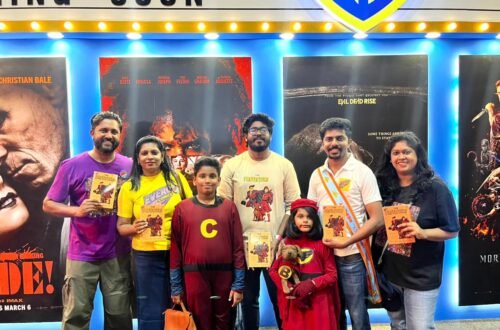
The Protectors: The Battle of the Unearthly by Harikrishna Ajayakumar expanded the catalogue into visual storytelling through Evero Comics. Combining historical fantasy and action in a comic-book format, the title became an Amazon bestseller across multiple categories and was later showcased at Comic Con Kerala.
Each publication added something more valuable than sales numbers.
It added trust.
The journey also reflects a broader shift within publishing itself.
Technology has lowered certain barriers that once made publishing accessible only to large institutions. Distribution networks have expanded. Print-on-demand systems have become more efficient. Independent presses can now reach global readers without requiring the infrastructure that publishers needed a generation ago.
What has not changed is the importance of editorial judgment, consistency, and relationships.
Books still depend on people.
Authors still depend on publishers.
Readers still decide what succeeds.
As Vandana enters her early twenties, the conversation around Verzove has gradually shifted. The question is no longer whether someone can build a publishing house at 19.
The evidence already exists.
The more interesting question is what happens when a company that began as an ambitious experiment grows into a recognised publishing platform.
For many founders, youth is treated as a disadvantage.
In hindsight, it can also become an advantage.
Starting early leaves room to learn publicly, adapt quickly, and build experience at a pace that few traditional career paths allow.
The story of Verzove is ultimately not about age.
It is about persistence.
It is about choosing to enter an industry before feeling fully qualified.
And it is about discovering that credibility is rarely something you wait to receive.
More often, it is something you build one book at a time.