Publishing is an industry that tends to trust experience.
Editors spend years refining their judgment. Publishers build careers title by title. Most people arrive at leadership positions after decades of observing how books move from manuscript to reader.
The assumption is understandable. Books carry weight. Authors place years of work into a publisher’s hands. Trust matters.
Which is why the story of Verzove stands out.
Founded in Indore, Madhya Pradesh, by Vandana at the age of 19, Verzove entered an industry where most founders have already spent years building credentials before launching a publishing venture. At an age when many students are still deciding on career paths, Vandana was learning the mechanics of publishing while simultaneously building a company around them.
The challenge was not merely operational.
It was credibility.
A young publisher often faces questions that older publishers never hear. Can they handle manuscripts professionally? Do they understand the industry? Can they support authors beyond the publication date? Will the business still exist a year from now?
These concerns are not unique to publishing. They appear in almost every industry where youth is often mistaken for inexperience and inexperience is assumed to mean incapability.
The publishing world, however, offers a useful test.
Books create visible outcomes.
A manuscript is either published or it is not. Distribution either exists or it does not. Authors either receive support throughout the process or they do not.
Results are difficult to hide behind rhetoric.
Over the years, Verzove has built those results into a catalogue that now includes more than 100 published authors. The publishing house operates with an all-inclusive publishing model and a manuscript-to-publication turnaround that can be as short as 30 days. Its books are distributed globally through Amazon, Kindle, and Google Books, allowing authors to reach readers beyond regional boundaries.
Those numbers matter for a simple reason.
They represent evidence.
For young founders, evidence often becomes the substitute for a lengthy résumé.
The story is not really about age. It is about the ability to create trust before traditional credentials exist.
Publishing history is filled with examples of institutions that earned authority through consistency rather than legacy. Independent presses rarely begin with prestige. They build it gradually through the quality of the books they publish and the relationships they maintain with authors.
Verzove’s catalogue reflects that process.
Half Love by Abhishek Shivhare, originally written in Hindi during the author’s first year of college, found a wider audience through its English edition and became an Amazon bestseller. At 137 pages, it is the kind of book many readers finish in a single sitting.
Drafts by Aaradhana Yadav achieved Amazon bestseller status in poetry, one of the most competitive and difficult categories for discoverability.
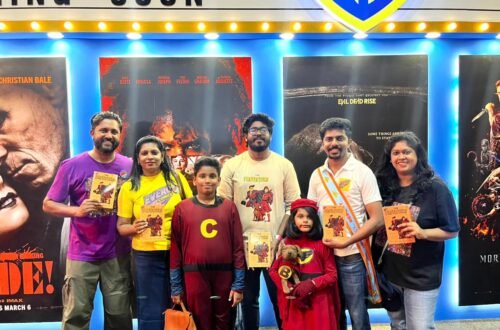
The Protectors: The Battle of the Unearthly by Harikrishna Ajayakumar expanded the catalogue into comics through Evero Comics. Set in the 1930s, the story follows a courier, his dog, and a woman as they confront a growing tyrannical force. The title became an Amazon bestseller across multiple categories and was later showcased at Comic Con Kerala.
Each title contributes to something larger than sales figures or rankings.
Together, they form a record.
That record becomes increasingly important when the founder’s age is the first thing people notice.
For many young entrepreneurs, credibility is often treated as something that arrives later. The assumption is that authority follows age, and age follows time.
Publishing suggests a more complicated reality.
Authority often follows delivery.
Authors remember responsiveness. They remember professionalism. They remember whether deadlines were met and whether promises were honoured. Readers remember books. The industry remembers outcomes.
A founder’s age may begin the conversation, but it rarely determines how the conversation ends.
Today, as Verzove continues to grow from its base in Indore, the company’s story offers an interesting case study in independent publishing. It demonstrates that while experience remains valuable, credibility is not exclusively tied to years spent in an industry.
Sometimes it is built through persistence.
Sometimes it is built through execution.
And sometimes it is built by a 19-year-old named Vandana who decided to start publishing books before anyone expected her to.
The publishing world still values experience.
But increasingly, it also values proof.
And proof, unlike a CV, does not care how old you are.